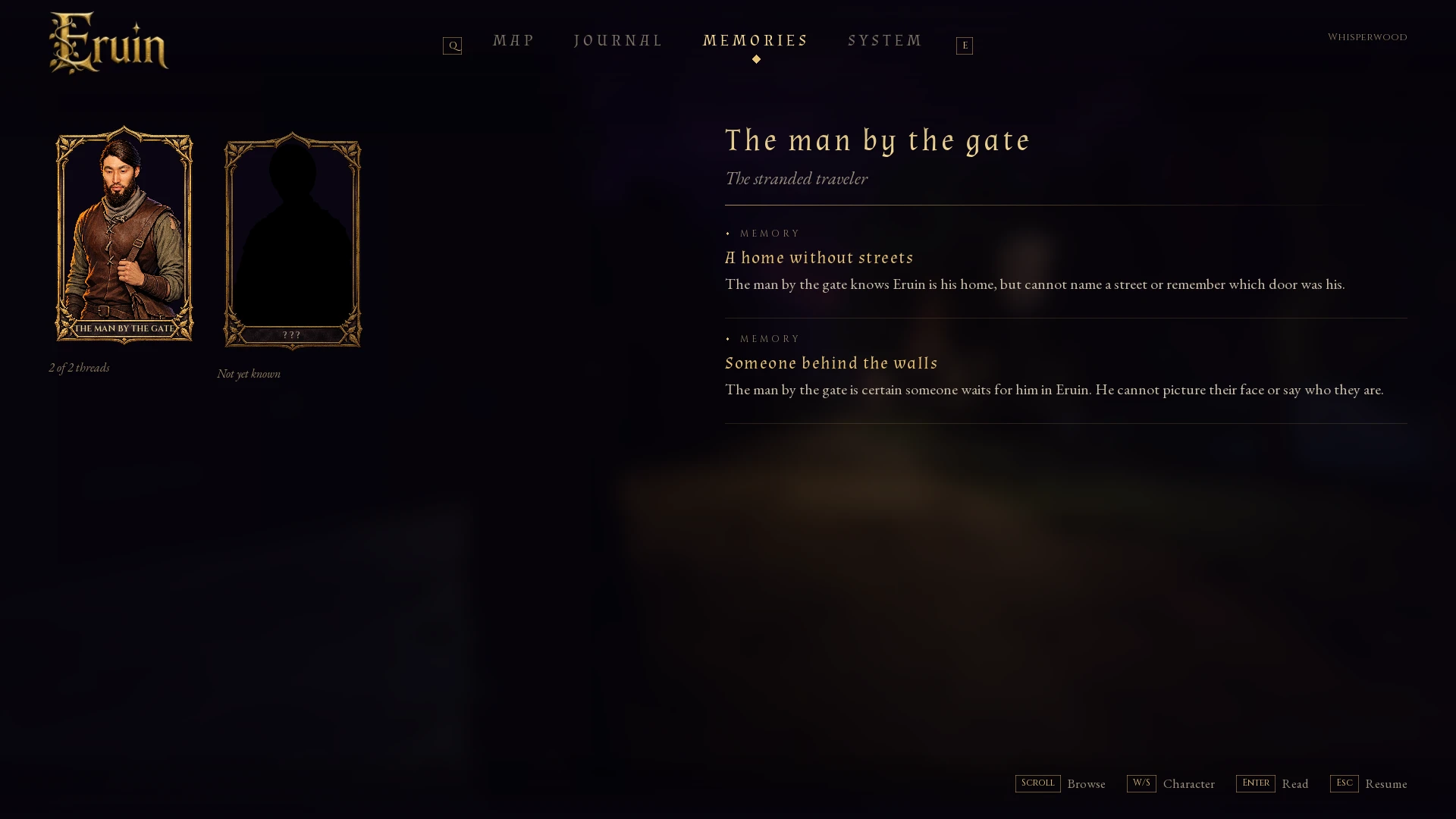
Development interface preview. View the Memories screenshot at full size.
Updated October 27, 2026: the screenshots now show the current build, where Memories and the Map are pages of the new pause menu. More in Faces in the Long Night.
A man outside the gate knows this is his home. Ask him about it, though, and he cannot name a street or remember which door was his. There is a town behind those walls, and a whole life he cannot reach.
That is the kind of discovery we want you to carry through Eruin. Our latest development build gives those moments a place of their own: Memories, a new screen for revisiting the fragments you uncover through conversation.
A question leaves a trace
Talking to someone can reveal more than the next step of a quest. A question about home, or about something they cannot quite remember, can uncover a small piece of their story. When you discover one of these fragments, a notification marks the moment and a card is added to Memories.
The first collection is deliberately small. We are starting with a few details already woven into the opening encounters, giving you a way to revisit what you learned without introducing a wall of new lore. Discoveries stay with your save, and returning to a familiar subject does not award the same fragment again.
Memories is optional. You can follow the immediate adventure, or linger with a character and ask another question. We want that curiosity to have somewhere to go.
Even a name is a discovery
Forgetting should reach beyond what a character says. It should affect what the game tells you, too.
In the current build, the traveler begins as the man by the gate. His name enters the interface when you learn it through the story. Guessing it in a conversation does not skip that moment. The witch's own name remains unrevealed in the opening adventure.
It is a small change with a useful effect: the interface can share your uncertainty. A name becomes something that happened between you and another person.
Finding your way
Memories also has a Map tab. Once you have learned a character's name, you can choose to follow their marker and see where they are. The selected marker moves with the character while the map is open.
The city stays obscured until you enter it. We want the map to help you find your bearings while leaving a reason to wonder about what lies beyond the gate. Your discoveries and the revealed city map are remembered when you save and return.
Free conversations, authored discoveries
There is an important design choice underneath the cards. Characters can answer in their own words through Eruin's local dialogue system, but the fragments recorded in Memories are written by us. Each has a defined source and conditions for discovery.
That lets a conversation find its own wording while keeping the recorded story grounded in the world we are building. We are still testing how reliably different local models recognise those discovery moments.
These are features in the current development build as we work toward the demo. Next comes more playtesting of discovery timing and the experience of moving between conversation, Memories and the map.
If you would like to explore the Long Night yourself, wishlist Eruin on Steam.